
Ötzi the Iceman's Gut Is Still Alive — and Quietly Evolving in a Museum Freezer
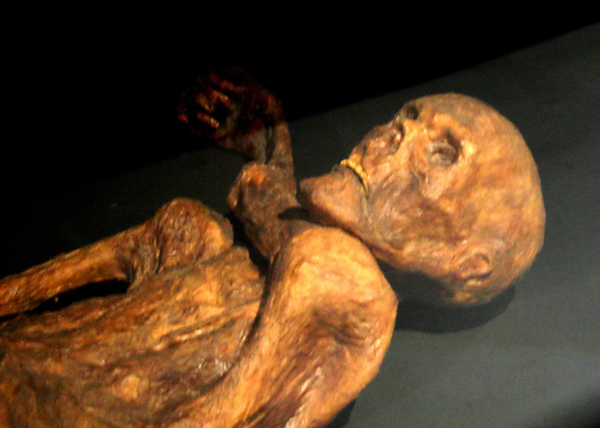
The man was shot in the back with an arrow sometime around 3300 BCE, fell face-down in a high alpine gully, and was locked in glacial ice for more than five millennia. He was supposed to be inert — a frozen snapshot of Copper Age Europe. He is not.
A study published in the peer-reviewed journal *Microbiome* by researchers at Eurac Research's Institute for Mummy Studies in Bolzano, Italy, has established that the microbial world inside Ötzi the Iceman is not merely preserved but demonstrably active, still metabolizing, and — most strikingly — still changing. The lead investigators, Frank Maixner and Mohamed Sarhan, describe Ötzi not as a static relic but, in their own phrasing, as "a dynamic biological system." That is an extraordinary thing to say about a body dead since before the first Egyptian pyramid was built.
The team conducted metagenomic sequencing of tissue samples drawn from Ötzi's gut interior and skin surface, distinguishing carefully between three layers of microbial history: organisms that lived inside him when he was alive, cold-adapted species that colonized his body during the millennia he spent entombed in glacier ice, and modern contaminants introduced since his 1991 discovery. The internal tissues told the more striking story. Deep in the gut, researchers identified anaerobic bacterial species — including *Treponema succinifaciens*, *Kineothrix* species, and several members of the *Ruminococcaceae* family — that are characteristic of the mammalian digestive system and almost entirely absent from the guts of contemporary Western humans. Their presence confirms a direct biological thread to Copper Age gut ecology, a microbiome shaped by a diet and environment that industrialized humanity has since erased.
But the most arresting finding was not ancient at all. Four strains of cold-adapted yeast were cultured from Ötzi's skin and from thawed glacial meltwater associated with his storage conditions. Genetic analysis showed DNA damage levels consistent with organisms that had been in the body since shortly after death — not later contaminants. When researchers compared those yeast populations against samples taken nine years earlier, the strains had shifted: species capable of metabolizing phenol, a disinfectant routinely applied to the mummy during conservation work, had proliferated even at the sub-zero temperatures in which Ötzi is stored at the South Tyrol Museum of Archaeology. The microbes are adapting to their environment. In a body over five thousand years dead. In a sealed, refrigerated museum case.
The sourdough detail has, predictably, captured headlines, and it is genuinely remarkable: Sarhan's team cultured the yeasts, demonstrated their leavening viability, baked bread with them, and reported the result as tasting, in Sarhan's words, "very, very good." That is both a scientific result and a deeply strange moment — a loaf risen by organisms that last metabolized inside a living human body when the wheel was new technology. But the baking experiment is almost a sideshow. The preservation implication is the harder news.
If microbial populations inside a specimen stored at minus six degrees Celsius are actively evolving in response to conservation chemicals applied over the last three decades, then Ötzi's microbiome is being quietly rewritten in real time. The external skin microbiome has already been substantially overwritten: the study found that humidifying spray water used to keep the mummy from desiccating has introduced a dominant modern bacterial signature across the surface, effectively layering a 21st-century microbial fingerprint over a Neolithic one. Maixner's team was direct about the implication — the protocols being used to preserve Europe's most studied prehistoric human may be simultaneously corrupting a unique record of ancient microbial life.
For researchers working on ancient DNA and microbiome reconstruction across the broader field, this is a methodological alarm. Ötzi is not unique in being held under imperfect preservation conditions; he is unique only in being studied closely enough that the contamination can be measured. What is happening inside his body is almost certainly happening, unmonitored, in museum collections worldwide.
There is also a deeper scientific thread here that tends to get lost in the sourdough coverage. The anaerobic gut bacteria identified in Ötzi's interior — organisms like *Treponema succinifaciens*, which ferments complex plant carbohydrates and is common in the guts of non-industrialized populations today but rare in the Western gut — are a data point in one of modern medicine's live debates: the relationship between gut microbiome composition, diet, and chronic disease. Ötzi's gut is, in this sense, a Copper Age control sample for a question that modern clinical trials cannot easily answer. The fact that we may have been chemically altering that sample during the decades we spent studying it is the kind of irony the scientific establishment rarely flags loudly enough.
The South Tyrol Museum of Archaeology has held Ötzi since 1998. He has been the subject of over a hundred peer-reviewed publications. His genome has been sequenced. His last meal has been identified. His tattoos have been mapped. His cause of death — that arrow wound to the left shoulder — is beyond dispute. But the study from Eurac Research is a reminder that the most researched individual in prehistoric science is still, in a measurable sense, not done surprising us.
Who is covering this (18+ outlets)
- YahooScientists Use Guts of 5,300-Year-Old Mummy to Make 'Very, Very Good Sourdough'
- International Business Times UK5,300-Year-Old Mummy's Yeast Helps Scientists Create a 'Very Good Sourdough
- Perez HiltonScientists Find Yeast In The Gut Of A 5,000-Year-Old Mummy, Make Sourdough Bread With It, Eat It, And Now They're Going To Do WHAT?! OMG!
- GreekReporter.comAncient Yeasts Found on Ötzi the Iceman May Still Be Alive, Study Finds
- Boing BoingScientists use yeast from body of Ötzi the Iceman to make "very very good" sourdough
- RayHaber | RaillyNewsRaillyNews - Sign of Life in Ötzi, the 5,000-Year-Old Ice Man
- ZME ScienceScientists Baked Bread Using Yeast from Ötzi the Iceman's 5,000-Year-Old Mummy and They Say It Tasted 'Very Good'
- BreitbartScientists Make Sourdough from Yeast Found Inside 5,000-Year Mummy
- Earth.comScientists uncover microbes growing inside Otzi, a 5,300-year-old Ice Age mummy
- 7NEWS.com.auBake from the dead: Ancient mummy yeast revived into sourdough
- dunyanews.tvScientists find yeast in ancient Iceman
- The Manila timesScientists make bread with yeast found in Iceman's guts
- THE LOCAL REPORT ARTICLESEurope's oldest mummy, 5,300 years old, may be 'alive': Scientists reveal shocking microbial activity World News - THE LOCAL REPORT ARTICLES
- The Times of India5300-year-old Europe's oldest mummy may be 'alive': Scientists reveal shocking microbial activity
- Irish IndependentMummy's made a sourdough - Otzi, the 5,300-year-old mummy, that is
- The Scottish Sun'Very good' sourdough made from yeast found inside 5,300-year-old mummy
- Superhits 97.9 Terre Haute, INScientists reveal Ötzi the Iceman's dynamic microbial world
- english.news.cnStudy suggests microbes associated with Iceman Otzi may remain biologically active
See what people are saying about this story on X.